
Nearly 179 million square feet of U.S. self-storage space now comes from repurposed buildings — about 10% of the country’s entire supply, with half of that delivered in the last decade alone, according to a recent StorageCafe study analyzing conversion projects across 1,184 cities. As land gets scarcer and vacant retail and office properties pile up, adaptive reuse has gone from a niche strategy to a core part of how the self-storage industry grows. Here’s where it’s happening most.
Demand for storage has expanded well beyond the traditional “4Ds” (death, divorce, dislocation and downsizing). As homes shrink in size and urban living becomes denser, storage units increasingly serve as an extension of the home — a place for seasonal items, business inventory, recreational gear, or simply the overflow of modern life. In land-constrained, regulation-heavy metros, developers are turning to adaptive reuse: converting underused industrial buildings, former retail stores, and outdated office space into self-storage facilities rather than building from the ground up.
East Coast and Midwest Lead the Way
Data show the East Coast and Midwest are effectively tied in the conversion race, each placing four cities among the top 10 for overall adaptive reuse inventory.
That dominance isn’t accidental. These regions are rich in legacy industrial and commercial properties—from early 20th-century warehouses to mid-century manufacturing facilities—many of which offer ceiling heights, structural integrity and central locations that make them strong candidates for conversion.
For self-storage operators, these buildings represent opportunity: established neighborhoods, built-in infrastructure and strong local demand.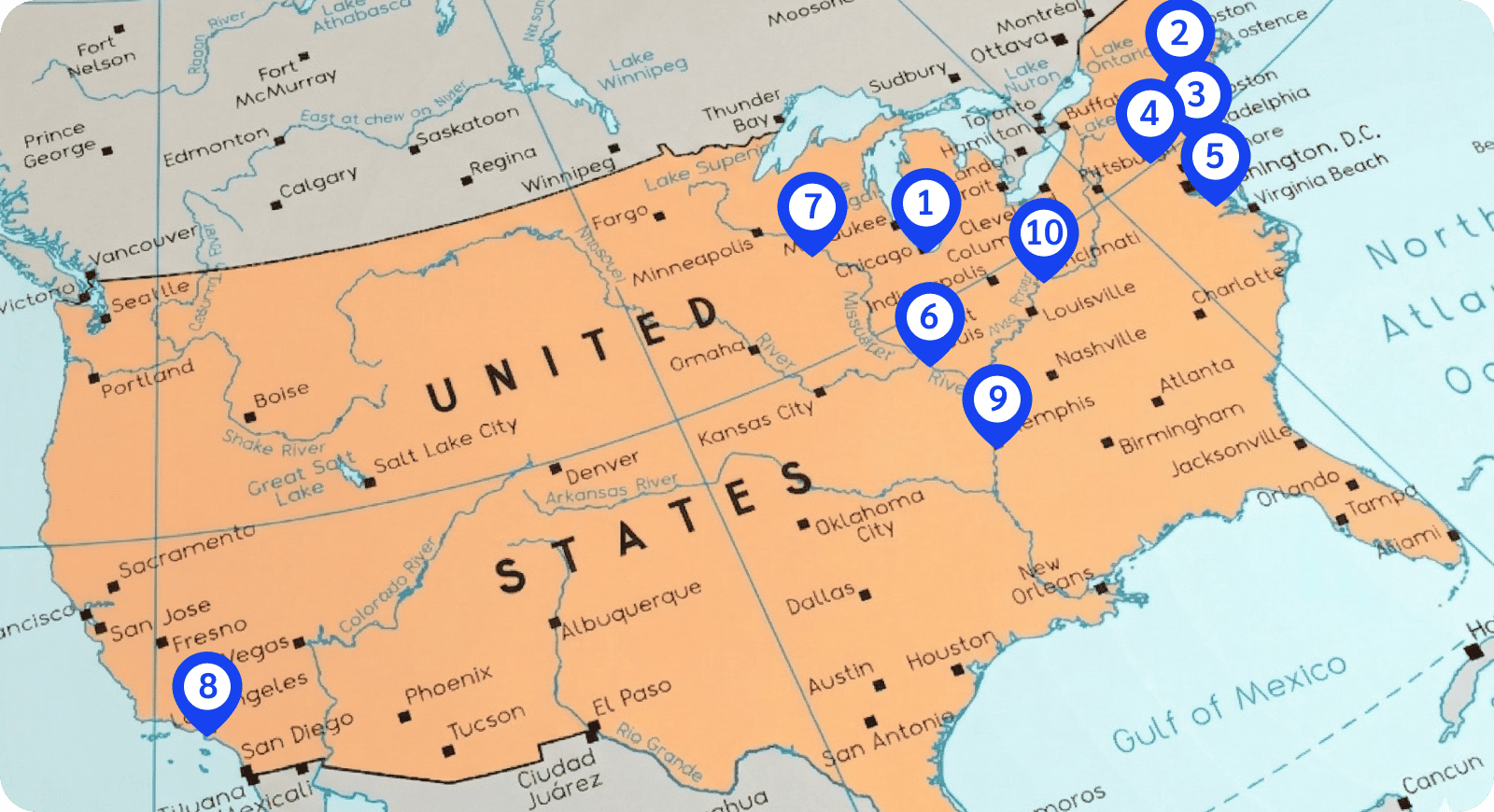
Below, we take a closer look at the 10 cities where adaptive reuse plays the largest role in shaping self-storage supply — and what each market’s conversion footprint suggests about demand, competition and development momentum.
1. Chicago, IL
Chicago leads the nation in self-storage adaptive reuse, with 4.4 million square feet of converted space across more than 60 facilities. That accounts for roughly 36% of the city’s total inventory, underscoring how central conversions are to Chicago’s storage landscape.
The added space is particularly meaningful in a market that remains undersupplied, with just 3.5 square feet of storage per capita. In 2025, Chicago is projected to add more than 150,000 square feet of storage through conversions alone — exceeding expected ground-up development by over 100,000 square feet.
About 12% of converted facilities are located in opportunity zones, reflecting the intersection of adaptive reuse with broader neighborhood reinvestment efforts. Repurposing existing buildings has also helped the city avoid an estimated 570,000 tons of demolition debris, highlighting the environmental upside of reuse.
Most of Chicago’s conversions originate from industrial (42%) and office buildings (42%), demonstrating the flexibility of older commercial stock. On the pricing front, converted facilities average $134 per month, about 14% less than units in purpose-built properties — a competitive edge for renters.

2. Brooklyn, NY
Brooklyn ranks second nationally with nearly 3.2 million square feet of converted self-storage space — close to half of the borough’s total inventory.
With only 2.1 square feet per capita, Brooklyn remains one of the most undersupplied storage markets in the country. Adaptive reuse has become a key tool for expanding capacity in a borough where developable land is scarce. More than one-third of conversions are located in opportunity zones, further linking storage growth to broader redevelopment activity.
Even with new projects expected to add roughly 125,000 square feet of converted space by the end of 2025, supply remains tight. That dynamic keeps rents elevated: conventional units average $229 per month, while converted facilities come in slightly lower at $218, a modest 5% discount.
3. Philadelphia, PA
Philadelphia has delivered an impressive 2.3 million square feet of converted self-storage space, blending industrial reuse with urban revitalization.
More than half of that retrofitted inventory is located in opportunity zones. By preserving existing structures rather than demolishing them, the city has avoided roughly 304,000 tons of construction debris.
Despite steady conversion activity, Philadelphia remains undersupplied at 3.3 square feet per capita. Developers are expected to add over 235,000 square feet of storage in 2025 — all through adaptive reuse.
Pricing reflects competitive conditions: traditional facilities average $150 per month, compared to $141 at converted properties, a 6% difference.
4. Manhattan, NY
In Manhattan, adaptive reuse accounts for more than 2 million square feet of self- storage — nearly half of the borough’s total inventory.
Most conversions stem from former industrial buildings, totaling over 1.3 million square feet. Notably, all of Manhattan’s converted facilities are located in opportunity zones.
Even with substantial reuse activity, Manhattan remains severely undersupplied at just 2.1 square feet per capita. The borough is expected to add another 308,000 square feet of converted space by the end of 2025.
Converted units average $231 per month, roughly 17% less than conventional facilities — a significant pricing gap in one of the country’s most expensive real estate markets.
5. Queens, NY
Queens has added more than 2.1 million square feet of storage through conversions, representing about 42% of total local inventory.
Like the rest of New York City, land scarcity drives the heavy reliance on adaptive reuse. However, no new conversion projects are scheduled for 2025, even as more than 233,000 square feet of ground-up development is expected.
Rents highlight the borough’s supply-demand imbalance. Conventional units average $280 per month, while converted facilities rent for about $181 — a striking 35% discount, one of the largest spreads among the top 10 cities.
6. St. Louis, MO
St. Louis ranks second in the Midwest for conversion activity, with nearly 1.7 million square feet of retrofitted storage space, accounting for 36% of total inventory.
Many of these facilities are located in opportunity zones, underscoring the link between adaptive reuse and redevelopment efforts. The city has also avoided an estimated 215,000 tons of demolition debris by converting buildings.
With 4.8 square feet per capita, St. Louis has more breathing room than coastal markets. No new conversion projects are currently slated for 2025, suggesting a pause in the adaptive reuse pipeline.
7. St. Paul, MN
St. Paul stands out for the sheer dominance of conversions: 1.4 million square feet of storage space — a remarkable 82% of total inventory — originates from adaptive reuse, the highest share among the top 10.
All converted facilities are located in opportunity zones, linking storage development to broader neighborhood reinvestment strategies.
Despite this strong reuse footprint, St. Paul remains undersupplied at 3.3 square feet per capita, and no new projects are projected for 2025.
Converted units average $102 per month, nearly 30% lower than purpose-built facilities at $144, one of the most significant rent gaps on the list.
8. Los Angeles, CA
Los Angeles combines land scarcity with high demand, making adaptive reuse a practical solution. The city has added roughly 1.4 million square feet of converted space, representing 14% of total inventory.
Unlike many markets, most LA conversions stem from office buildings (57%), followed by industrial properties (38%). All converted facilities are located in opportunity zones.
Storage availability remains extremely tight at just 2 square feet per capita. Conventional units average $273 per month, while converted facilities rent for about $224, an 18% discount.
Looking ahead, Los Angeles is expected to add 538,000 square feet of converted storage in 2025 — more than one-third of its projected pipeline.
9. Memphis, TN
Memphis has delivered nearly 1.4 million square feet of converted storage, accounting for about 22% of total inventory.
Retail-to-storage projects dominate here, accounting for 53% of conversions. Converted units rent for about $84 per month, 21% lower than conventional facilities, which rent for $102.
With 8.2 square feet per capita, Memphis stands out as the most balanced market among the top 10. An additional 44,000 square feet of converted space is expected by the end of 2025.
10. Cincinnati, OH
Cincinnati rounds out the list with more than 1.3 million square feet of converted storage — nearly one-third of total local inventory.
About 25% of conversions are located in opportunity zones. While rents are more moderate than in coastal markets, converted facilities still offer a pricing edge: $97 per month, compared to $103 at conventional properties.
Like many Midwestern cities, Cincinnati’s legacy building stock continues to provide viable repositioning opportunities as storage demand remains steady.
Across these markets, adaptive reuse has evolved from an opportunistic strategy into a core development pathway. In cities where land is limited and demand remains strong, converting existing buildings into self-storage facilities is helping reshape the urban storage landscape — one warehouse, office block, or former retail store at a time. For developers, the pipeline of repositionable assets shows no sign of shrinking. For renters, conversion facilities continue to offer a meaningful pricing advantage over purpose-built alternatives. And for the industry overall, adaptive reuse is increasingly the answer to the question of where new supply comes from in constrained markets.

.png)
%20(1).png)
.png)